A major European health charity was spending serious money on lead generation: Getting the names of potential donors via a full campaign of social ads, landing pages. Then they would convert those leads to regular (monthly) givers via phone.
I asked the fundraising manager: what happens to the people who don’t convert?
He looked at me blankly.
“Oh, we don’t do anything with them.”
It wasn’t the first time I’d had that conversation. I’ve come across it at other organizations too – the focus goes entirely on converting new leads, and everything after it gets ignored.
The write-off mentality
Some organizations treat lead generation as a one-shot donor acquisition exercise. Run the campaign, get the leads, call the phone numbers, bank the donors, move on. Everyone else gets ignored or forgotten.
And here’s the thing that gets lost in that approach: the word “leads” itself is part of the problem. It belongs to a “widget sales” pipeline strategy.
Your nonprofit leads are people who signed your petition, took your survey, said they care about your cause. They believe in what you’re doing. They align with your values. If they don’t donate straight away, that’s not a failed transaction – it’s still the start of a lifelong relationship of potential involvement and support.
The long tail is real
A few years ago, I worked with Bush Heritage Australia to study what happened to new leads who didn’t convert in their initial phone conversion campaign. The calling program ran for about eight weeks after someone took a survey or quiz. After that, the unconverted supporters went onto the email list – and we tracked whether they eventually became donors on their own.
The results were striking. Those later conversions – happening after the initial campaign had ended – increased total monthly donors converted by 58%. They boosted monthly giving income by 42% over the following 2.5 years. New donors were still appearing more than 30 months after their first engagement. Single giving showed a similar pattern.

I’ve seen the same long tail at other organizations – a steady stream of conversions from people who came in through lead generation.
But I’ve also seen organizations where it barely happens.
What’s the difference?
Two things matter
First: how well do you keep the relationship alive?
The organizations that see this long tail of conversion engage supporters all year round – not just at appeal time.
Great stories about the impact of their support. Other ways to participate. Little touchpoints with the legacy program, just planting a seed. Community fundraising offers. Supporter surveys. A frequent, quality dialog that builds commitment to the cause.
This means treating email as the backbone of an ongoing relationship – not an add-on you dust off at appeal time.
The orgs that dump people on a list and only email twice a year for money? They don’t see the long tail.
Second: how well do your asks align with why someone engaged in the first place?
This matters for the initial conversion campaign and every ask that follows. The values and motivations someone expressed when they first engaged should echo through every subsequent offer you present them with.
I worked on a campaign for Soi Dog (an animal welfare organization based in Thailand) that’s a great example of this.
First, they asked supporters to sign a petition to save dogs from the meat trade. Then, they offered the chance to buy a billboard (effectively a one-time gift) to help save more dogs. Then, they invited supporters to give monthly to care for the dogs they’d helped save. Each step tapped into the same values and emotions that brought someone in.
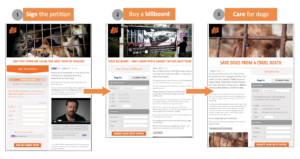
Compare that to a less relational approach, such as a generic ask that ignores why someone signed up in the first place.
Think broader, think longer
There’s a hangover from the direct mail era at play here. With direct mail-only fundraising programs, you would run big acquisition campaigns, convert what you could, and build your donor file. Email – if anything – was tacked on as an afterthought.
In a digital world however, you need to think in terms of a spectrum of engagement. Your website visitors, email subscribers, social followers, petition signers – they’re not all donors. Not yet. But they are strong prospects who may convert if you treat them right.
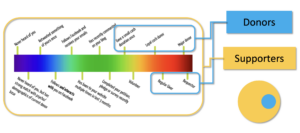
And don’t just think in terms of big campaign pushes. Every touchpoint is a step toward someone donating. Someone who follows you on Instagram and receives your emails might engage with your stories 12 or 20 times over 10 months and then give for the first time. Not necessarily because of a big campaign push, but because you’ve inspired them. Or simply for their own reasons.
A small number of conversions each week, consistently, compounds into something substantial over time. That’s a fundamentally different cadence to big-spend, big-push acquisition campaigns. Both are part of a healthy acquisition program.
One structural point that matters here: this works best when fundraising and communications aren’t siloed.
The people managing your emails, your social media, and your content need a fundraising mindset even when they’re not making direct asks. Every story and every update should place supporters at the center of impact and change. You’re building toward giving with every touchpoint, not just the ones that say “donate.”
And conversely, your fundraisers need to appreciate the value of the whole funnel – not just the small end — that is, current donors.
The upside you can’t predict
A mid-size Australian charity I know had a woman following them on Facebook for a couple of years. She never donated. Until she did – with a first gift of $300,000.
That’s an outlier. But it happens.
It might not have happened if they’d dropped her after one attempt to get a donation.
Less of an outlier is legacy giving. All of us are heading to the same place in the end, and many of us will leave a gift to a charity in our wills when we get there – serious numbers.
Around half of people who leave a legacy to an organization never donated to it before. They’re not in the donor database. So where did they build enough loyalty to leave money in their will?
Many touchpoints over time. Some of those would be via PR. Some would be direct mail they read but never responded to.
And of course, some of those touchpoints will be online – your social media, your digital ads, and your ongoing, relationship-building email program. All those stories you told. All those seeds you planted.
People who don’t know about you can’t leave you a legacy. But people who do, might.
Stop ignoring them
The question isn’t “how many donors did we convert on the phone from our last lead gen campaign?”
It’s “what are we doing with the 95% of leads who didn’t convert yet?”
And remember: they’re not just “leads.” They’re members of your community.
If this is the kind of thinking you’d like more of – grounded, practical, donor-centered fundraising that actually works – join the waitlist for Fundraisingology Lab. We’ll let you know the moment membership opens.
Related Blog Posts:
- Your To-Do List for Skyrocketing Income in the Coming Years
- How Important Is That Awareness Campaign for Your Bottom Line?
- How to Welcome Your New Donors so They’re Happy to Stay