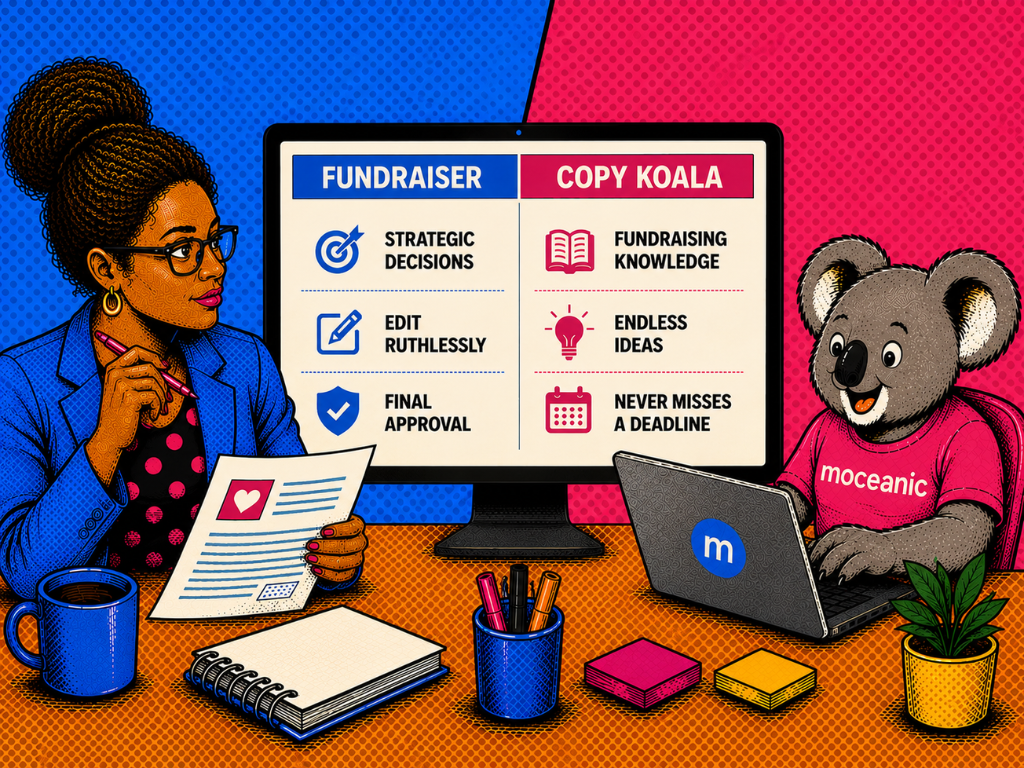
We at Moceanic just hired a new fundraising copywriter.
They bring a lot to the table: Knowledgeable about fundraising – they’ve studied and really know many of our Moceanic courses inside and out. They’ve also read several important books, and fundraising blogs. It’s almost scary how on top of this material they are!
On top of that, they’re incredibly fast. Never miss a deadline. (How many copywriters do you know who manage that?)
Their grammar, spelling, and writing mechanics are flawless.
They’re good-natured and agreeable. Never get the slightest bit defensive when you correct them.
But it’s not all perfect.
Sometimes they forget foundational fundraising truths. They’ll just omit something now and then.
They can be somewhat passive-aggressive. If you ask for a revision, just one specific point, they’ll write a whole new project – and not do that one thing you asked for. That sort of thing.
Now and then they make truly odd word choices, or strange leaps of logic in their writing.
And they seem to have very limited life experience. In a recent appeal, they included the story of someone getting a phone call, and the writer seemed to think a phone call is a type of communication that only includes one person.
You’ve probably figured out that our new copywriter is an AI.
Its name is the Moceanic Copy Koala. It is a valued part of Moceanic services.
Despite the weirdness.
Frankly, if I met a young copywriter with zero years of experience who wrote half as well as Copy Koala, I’d be pleased. I mean, it took me years to get from “terrible” to “okay” as a fundraising copywriter. Koala is past “okay” already.
I’ve learned a few things about working with AI. These might be helpful if you want to put it to work for your fundraising.
1. Do not use an AI that is untrained in fundraising basics.
Really, don’t just ask your AI tool to write a fundraising appeal. Even with thorough and intelligent prompting, this is a big waste of time.
AI “learns” from writing it finds on the internet. And most fundraising that’s sitting around on the web is bad. I mean really bad. The AI tools don’t know it’s bad. They just use it as a model. Result: ineffective fundraising. Confidently presented and grammatically flawless. But lousy.
Make sure your AI fundraising tool is well-trained, and that it is being refined as time goes along.
2. Always have careful and experienced human supervision over AI copy.
AI is a weirdo. It comes up with the strangest things, from hallucinations, sometimes mild, sometimes wild. It forgets things few human writers would forget. And the writing … so often it’s just weird. Clearly not human.
A human supervisor needs to be involved up front, making sure the AI gets good input. And then at the end, to make sure it sounds human.
Neither of these things is easy for anyone, least of all for someone without deep fundraising knowledge and strong instincts. And maybe a bit of a “mean streak” – a no BS attitude that doesn’t let garbage slip by. The only way I know of to get those things is to be active in fundraising for many, many years. Anything less won’t do. If you don’t have access to someone like that, you should not use AI to write your materials.
3. Edit with eagle eyes and a heart of ice.
This is the challenge. I struggle with this for two reasons:
First, AI doesn’t make the normal mistakes people make. The first draft is squeaky clean from a grammar perspective. It lulls you into a sense that because it’s so clean, it’s “done.” Because that’s what finished quality fundraising has looked like all your career. Until now. Your AI can present you with disastrously bad fundraising that looks perfect. Believe me, it’s hard to separate those two issues.
The second challenge is that AI tends to bowl you over with masses of content. Also known as AI Slop. It can wear you down by simply providing too much stuff. Part of your job as the human editor is to strip out the slop. But also you need to get through it without getting too weary to pay attention.
4. Know if you’re ready to use the tool.
This is important: If you are not very good at fundraising, AI is not going to save your bacon. It will make your fundraising worse. Faster. Cleaner. But worse.
AI fundraising will make a fool of you if you aren’t equipped to master the tool.
I have some good news for: You can work with Moceanic to put AI to work for you. At a cost that will shock you how low it is. Our human-guided Moceanic Copy Koala is already proving itself, bringing in results that absolutely smash expectations.
Want to find out more? Talk to Fundraisingologist Sean Triner. You just might like what he has to share with you!
Related Blog Posts:
- Before You Hand AI the Keys to Your Fundraising…
- How to Get Your Fundraising Emails Delivered
- AI Fundraising: 4 steps to getting