I’m lazy.
And I’ll (lazily) go out on a limb to say you’re lazy too.
I’m confident in saying that, because laziness is a basic human trait. We’re always looking for shortcuts and labor-savers. It’s just the way we are. Our laziness sometimes gets us in trouble, but on the whole it is a good thing – both for us as individuals and for human progress in general.
But something new and weird has happened: We have helpers who are not at all lazy. Because they are not human.
I’m talking about AI.
Our AI tools are freakishly un-lazy. And unnervingly fast.
That makes them good tools. But it requires us to be careful about how we use them.
Let me give you an example:
I was working on a direct mail appeal, using an AI tool (more about it in a bit). It was a typical appeal to donors. One of the things I wanted it to do was include a handful of versions of the letter for five donor groups: new donors, monthly donors, lapsed donors, high-end donors, and donors who’d given to this offer before.
The normal way we lazy human fundraising writers create difference versions is to limit the differences to one or two places in the letter. Maybe the first paragraph and/or the P.S. has content specific to the audiences. Keep it simple and straightforward.
The AI went a different way.
First, instead of five groups, the AI created versions for all the combinations of the five audience attributes. That is, if someone was new that was a version. If someone was new AND monthly, that was another version. And so on.
That adds up to 120 audience groups.
120 versions of the letter.
But it gets better…
Instead of limiting the different versions to a couple of variable paragraphs, the AI wrote an entirely different appeal for each possible audience group.
Instead of one awesome direct mail letter with minor changes to target five audience groups, the team and I had 120 direct mail letters – hopefully awesome, but we needed to carefully read them to make sure.
It took the AI a few minutes to write 120 different appeal letters.
It would have taken us human overseers weeks to make sure all of those letters weren’t terrible and were to the quality standard we require. Because that’s one of the things AI helpers do: They sometimes make wild mistakes. They need human supervision.
That’s classic AI slop. The downside of not being lazy.
I’m not saying you shouldn’t get help from AI with writing fundraising.
I am saying you need to be on your toes when you use AI help.
And anyone who is not good at fundraising will be just as not-good at it no matter how much AI help they get. They’ll just be faster at churning out ineffective fundraising.
Here’s what you need to get quality fundraising from an AI tool:
1. The AI MUST be trained in fundraising principles
Ask a general-purpose AI to write a donor appeal, and you’ll get something that sounds like a press release with a tin cup at the end. It’ll talk about your “impactful mission” and your “transformative work.” It’ll address the donor like a stakeholder, not a friend.
That’s because the AI has read a million corporate websites and not much fundraising. (And frankly, the fundraising it has read is mostly lousy.)
This is the hard part. It needs to know a lot about what works in fundraising, and it’s up to you to let it know!
2. You must oversee the work with expert supervision — and fact-check everything
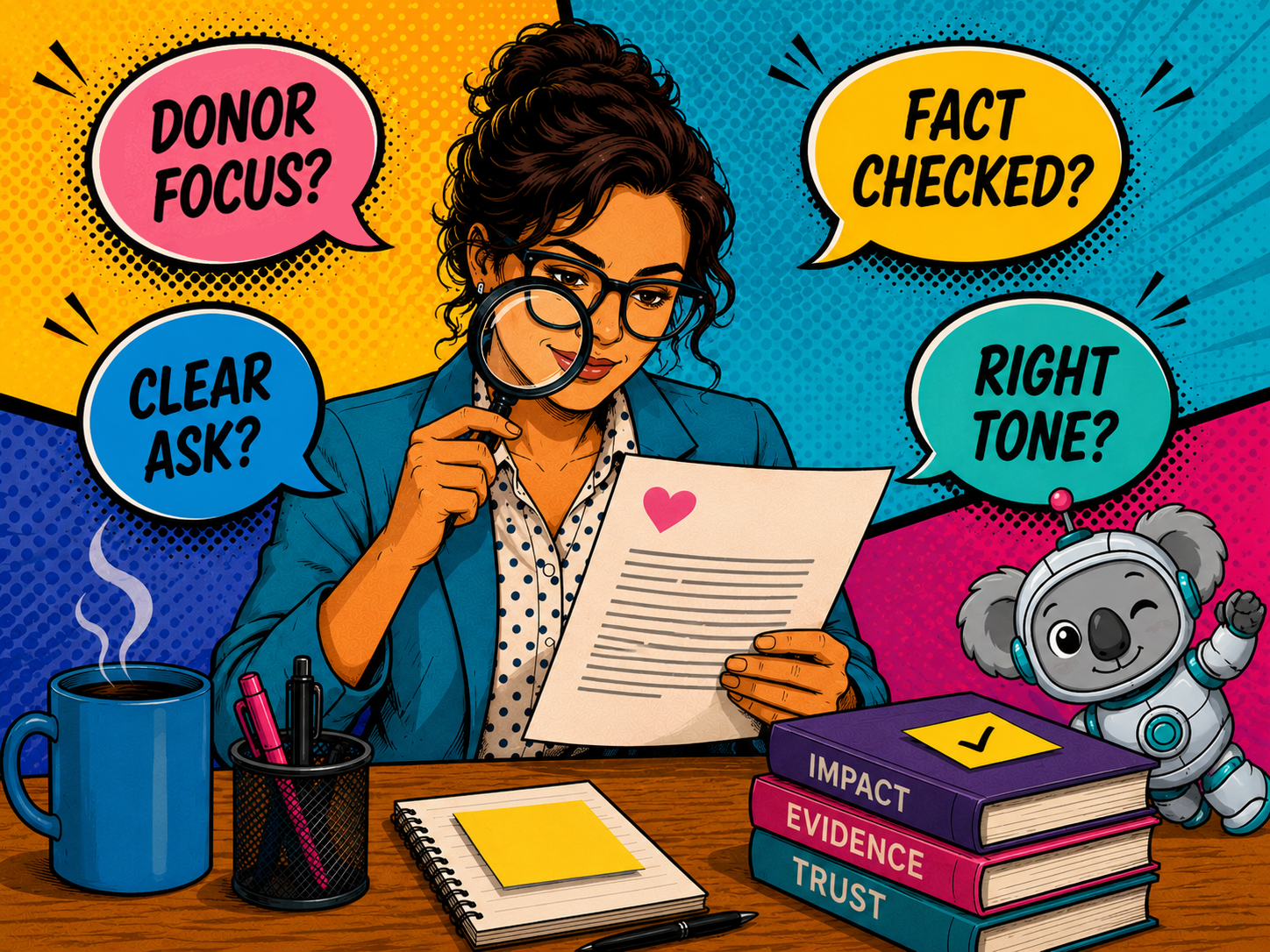
Someone who really knows fundraising must review what the AI gives you. Not for grammar – it’s very good at that. For fundraising sense and effectiveness. Even a well-trained AI has a tendency to hit you with AI slop now and then. Also, even a well-trained tool sometimes ignores important parts of its training.
An eagle-eyed experienced fundraising professional who really knows their stuff needs to go over the AI copy, like the clown with the big shovel who follows the elephants in a parade. There is always “stuff” that needs to be cleaned up!
And here’s the other thing: AI makes stuff up. Confidently. It’ll invent statistics, misquote your program, give your beneficiary a name and a backstory that don’t exist. Check every fact. Every single one.
3. Supply it with the complete information it needs
You wouldn’t hand a human copywriter three sentences and expect a brilliant appeal. AI is no different.
It needs a quality brief. Who’s the donor? What’s the program? What’s the specific ask? What’s the story you want told? What’s the tone? What’s the deadline? Who’s the signer?
The better your brief, the better the draft. Garbage in, garbage out — that rule didn’t die when AI showed up. It got more important. Put the time in.
Other material you should give it:
- Your brand guidelines or other general things you want it to pay attention to.
- The story (or stories) you want it to tell. A transcript of an interview can be enough.
- Any copy points or ideas you’d like to see included.
4. Pay attention to how you prompt the AI
Prompting is a craft. The way you ask the AI for something really matters for what you get back. Vague prompt, vague result. Specific prompt with examples, tone direction, and clear instructions — much better result. Learn from your mistakes and from the AI’s mistakes.
And here’s the tricky part: this stuff keeps changing. What worked six months ago might not work as well today. New models, new capabilities, new quirks. You have to keep learning. Fundraisers who get good at prompting have a serious edge.
Here at Moceanic, we are doing these exact things to put AI to work in fundraising for our clients. We have created a high-level tool called the Copy Koala. It is rigorously trained on our expert methodology, fundraising courses and thousands of our blog posts. We are constantly refining the training, as well as the best ways to brief it up front to create quality fundraising projects. And it is always under the supervision of one or more of our expert Fundraisingologists.
We are now using our AI tools with a handful of smart organizations to create quality, effective fundraising incredibly quickly and at an unbelievably low cost. Interested? We have capacity for a limited number of organizations who’d like to try out our AI service. Schedule a quick call with Sean Triner to find out how this could work for you.
Related Blog Posts:
- What Good Is AI for Fundraisers? [VIDEO]
- Before You Hand AI the Keys to Your Fundraising…
- How AI Writing Can Defeat Your Best Projects … or Not