
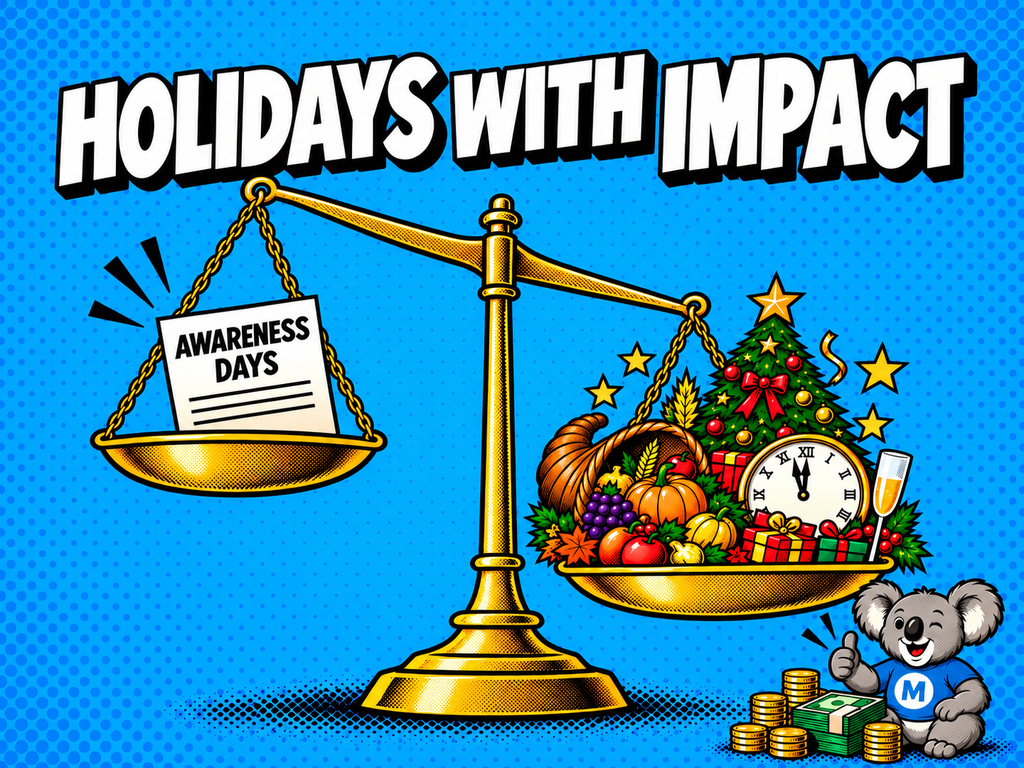
World Food Day is coming right up. If you are involved in food or nutrition, you simply must do a fundraising campaign for the occasion. Get right on it!
Actually, no. Don’t do that.
For almost everyone – including most of your donors – World Food Day is just another day. It has no connected traditions. No deep well of memories. Even for those who have heard of it (which is very few), “World Food Day” is a concept with no emotion attached.
That’s why World Food Day is a lousy fundraising platform. It doesn’t connect with the right side of the brain. It’s just a fact.
Basing your fundraising on the fact that it’s World Food Day is like going up to someone and saying “Today is Noah Webster’s birthday. Where’s my present?” (In fact, October 16 is Noah Webster’s birthday; feel free to give me a dictionary.)
October 16 is also World Spine Day, World Anesthesia Day – and in the US, National Feral Cat Day and National Boss’s Day. All important to somebody.
But not to your donors.
I’m not attacking the idea of these commemorative days. They have their purpose. And mentioning them in fundraising is not going to hurt anything – it’s just a waste of words.
What doesn’t work is fundraising that tells donors to “celebrate” a commemorative day by giving. One exception that works from some organizations (but not all) is Breast Cancer Month, October.
The good news is, there are some holidays that really do boost fundraising. It’s that cluster of special days running from late to November through the end of the year.
The Holidays. Around 40% of fundraising dollars come in during that time.
And the reason is these Holidays are tied to lifelong memories and deep emotions.
They can be strong levers for fundraising. They are:
Thanksgiving
(US; Canada has Thanksgiving also, but it doesn’t have the same pull-power.) This is a powerful fundraising occasion. The tradition of gathering for a special meal and the emphasis on gratitude make it good for fundraising. Especially food-oriented asks. Using the day as a deadline for a food-focused ask is strong. Also, directly encouraging donors to celebrate the things they are thankful for by donating can be very effective.
Hanukkah
A gift-giving holiday with a strong family angle makes it a natural for fundraising.
Christmas
A powerful holiday all over the place. There are two “versions” of Christmas that live alongside each other: The specific Christian holiday, and the secular version. If you are a Christian organization, you can and probably should focus in on the Christmas story: The babe in the manger, three wise men, all of that. If you are not faith based, you lean secular, and decorate your fundraising with candy canes, holly springs, snow flakes, and other images that remind people of Christmas.
Year-End
Important because it’s a tax deadline in many countries.
There are also a few Christmas-adjacent holidays around this time: Kwanzaa (celebrated by some in the US, Canada, and parts of the Caribbean), St. Nicolas Day (December 6), St. Lucia Day (December 13), Boxing Day (December 26; celebrated mainly in the UK, Canada, Australia, and New Zealand), St. Stephen’s Day (December 26). Do your donors celebrate these days? If so, they may be good fundraising occasions.
A note on the “culture wars” in the US. Think carefully about what you call the Christmas holiday. Is it “Christmas” or “the Holidays”? It’s a matter of sensitivity to some donors. Choose carefully!
Outside of November and December, there are a few other fundraising-forward holidays:
Easter
Really only for Christian organizations.
Passover(Spring) and the High Holidays
(Rosh Hashanah and Yom Kippur in the Autumn for Jewish organizations.
A couple of warnings about holidays that often don’t work, even if it seems they should:
Mother’s Day
It should work. But I’ve tried and tried, and haven’t yet pulled it off. Let me know if you’ve done it!
Your organization’s anniversary
Just don’t! Nobody cares, other than everyone you work with. It can be a motivating factor for boards, though.
A final note: this is based on my experience, which is mostly with US organizations. If you fundraise outside the US, some of this will translate directly and some won’t.
But here’s the principle for holiday fundraising, that applies no matter where in the world you live or fundraise. To be a donor-moving occasion, it needs to be deeply emotional to the donor you’re connecting with. With associated traditions, foods, and childhood memories. That’s why Awareness Days don’t do the job.
As with all fundraising, you always do better when you enter the donor’s world than when you try to pull the donor into your world.
Want to end your 2026 with a bang? Download our free guide, Your Calendar for Successful Year-End Fundraising. It gives you a suggested timeline to plan and execute year-end fundraising, especially focusing on December. It’ll give you clarity, confidence, and great results!
Related Blog Posts:
- Holidays That Boost Donor Giving — and the Rest You Can Ignore
- VIDEO: How to Plan Your Christmas Appeal in Advance for Maximum Impact
- Almost Everything I Know About Fundraising I Learned from Christmas Carols